
If you were hoping to get an IRA loan, here is the short version: you cannot. Borrowing money from a retirement plan is tempting — it is already your money, you do not have to get approval, and you will not owe a creditor. While some retirement plans, such as a 401(k), offer loan options, an IRA does not.
The good news is that you can sometimes find a workaround to temporarily access your IRA money by conducting an indirect rollover. However, there are real risks to this method, and it is not always an option.
Key Takeaways:
- You cannot take out a loan directly against your IRA the way you can with a 401(k).
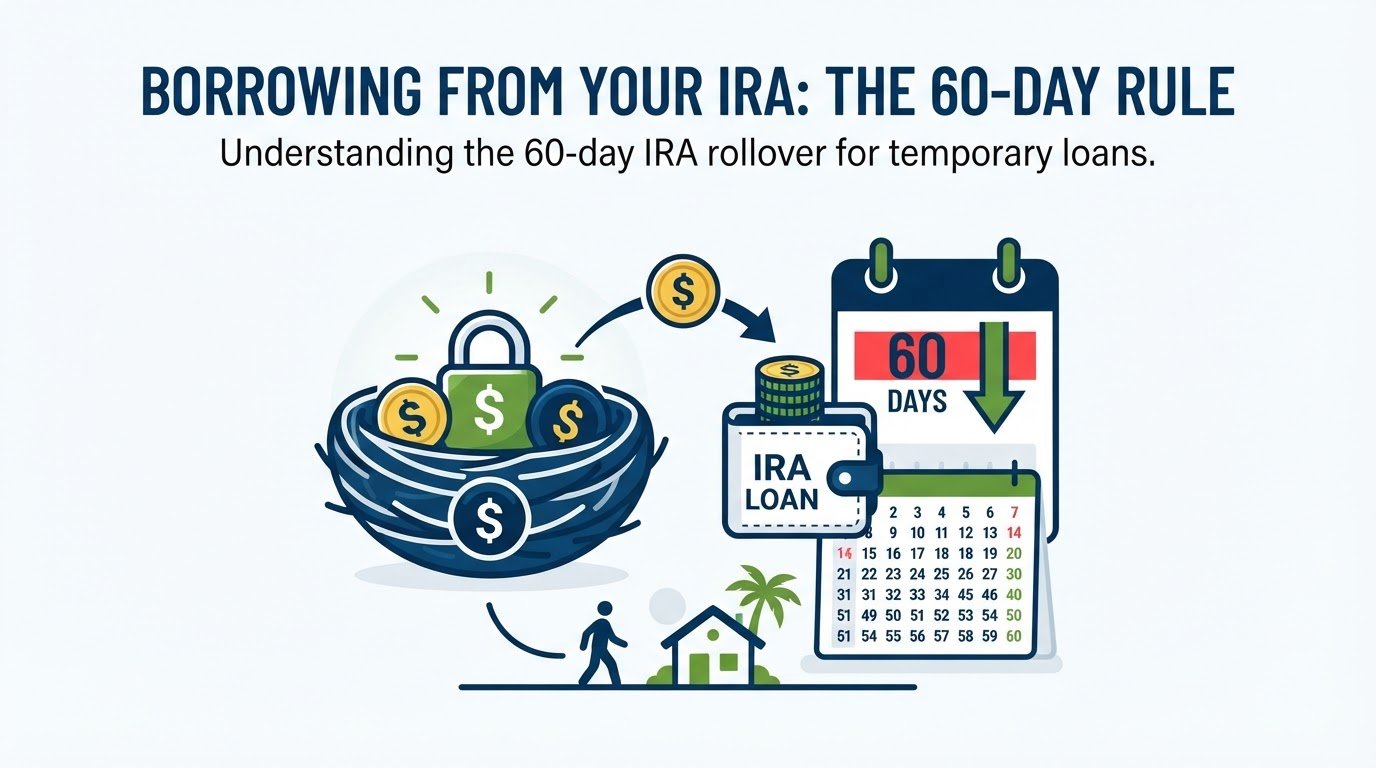
- An indirect rollover can give you short-term access to IRA funds, but the money must be redeposited within 60 days.
- You are limited to one indirect rollover per IRA every 12 months.
- If you miss the 60-day window, the withdrawal is taxed as a distribution and may trigger a 10% early withdrawal penalty.
- A 401(k) loan or a penalty-free withdrawal may be a better fit depending on your situation.
Why Borrowing Can Beat Withdrawing
When you need money, it is often better to borrow from a retirement plan instead of making a straight withdrawal. There are two reasons for this:
- You avoid the early withdrawal penalty. This normally applies to withdrawals from traditional tax-advantaged retirement accounts before age 59 1/2.
- You do not permanently lose the invested funds and their potential gains. When you withdraw money, you lose out on future compound interest, and your retirement account balance will ultimately be smaller. If you borrow instead, you put the money back in your account where it can keep working for you.
While borrowing can be better than withdrawing funds, it is not always an option — especially with an IRA.
Using an Indirect Rollover for a Short-Term IRA Loan
You cannot get an IRA loan, but you can make an indirect rollover. This is different from a direct rollover, where a distribution from a retirement plan is sent directly to another retirement account.
By contrast, an indirect rollover occurs when you receive a distribution from a retirement plan — in this case, an IRA. You are then responsible for depositing it into an IRA within 60 days. If you stick to that window, you will not incur an early withdrawal penalty, which opens up the opportunity to borrow from an IRA on a short-term basis.
If you need money and know you will be able to pay it back within 60 days, you can initiate an indirect rollover, use that money temporarily, and then pay it back to avoid a penalty. You do not even have to deposit the funds into a new IRA — you can stick them right back into your existing IRA.
The catch:
You are limited to one IRA rollover per 12-month period, and the strategy carries real risk. If you do not deposit the money back into an IRA within the 60-day window, the amount removed will be treated as a distribution — subject to ordinary income tax and a 10% early withdrawal penalty.
But if you just need a short, temporary influx of cash, using an indirect IRA rollover as a loan could work.
Penalty-Free IRA Withdrawals
Since you cannot get an IRA loan, you may consider withdrawing money instead. Be aware that if you take money out of your IRA, you will be taxed at your ordinary income tax rate unless it is a qualified Roth IRA withdrawal. You may also be subject to a 10% early withdrawal penalty unless you qualify for an exception, including any of the following:
- You are at least 59 1/2
- You meet the IRS definition of disabled
- You are taking substantially equal periodic payments
- You are withdrawing up to $10,000 toward the purchase of a first home
- You are paying medical expenses that exceed a certain percentage of gross income
- You are unemployed and using the money to pay medical insurance premiums
- You are paying past-due taxes because you are subject to an IRS levy
- You are covering eligible higher-education expenses
If you have a Roth IRA, you are always permitted to withdraw the money you have invested (your contributions) without incurring penalties. Penalties only apply to the early distribution of gains.
Consider a 401(k) Loan Instead
Although you cannot borrow from your IRA, it is generally possible to borrow from your 401(k) — depending on your plan’s rules. Normally, you may borrow up to $50,000, or 50% of your vested account balance.
Before borrowing or withdrawing from a 401(k) or IRA, carefully consider the risk to your retirement security and explore other available options.
The Bottom Line:
An IRA loan does not exist, but an indirect rollover can give you short-term access to your funds if you are confident you can redeposit within 60 days. The risks are real — miss the window and you face taxes plus a penalty — so weigh it against a 401(k) loan or a penalty-free withdrawal before you move any money.